
✓Board-certified pediatric dentists
✓Orthodontic monitoring built into your child’s routine care
✓Clear explanations, and treatment only when it truly benefits your child
✓We work with multiple insurance carriers and offer flexible financing solutions
Now accepting new patients. Is your child approaching age seven or showing signs of bite concerns? Call our Sunnyvale office today to schedule an evaluation and ask about insurance and financing, or request an appointment online anytime.
Most parents know that braces or orthodontic treatment may be in their child’s future, but fewer realize that the right time to start monitoring the situation is much earlier than treatment actually begins. The American Association of Orthodontists recommends that every child receive a first orthodontic evaluation no later than age seven. This timing is not arbitrary. By the time a child reaches this age, the first permanent molars have typically emerged, creating enough of a dental framework for an experienced clinician to evaluate how the bite is developing and whether any intervention is warranted. A 2022 systematic review published in the National Institutes of Health’s National Library of Medicine found that malocclusion, encompassing everything from crowding and spacing to crossbites and open bites, is the norm rather than the exception in children, with significant prevalence documented across all studied populations. Early evaluation doesn’t mean early treatment, but it does mean having the information needed to act at exactly the right moment.
At Bay Area Kids Dentist in Sunnyvale, CA, our board-certified pediatric dentists incorporate orthodontic monitoring as a natural part of comprehensive preventive care. Every dentist on our team holds board certification through the American Board of Pediatric Dentistry (ABPD), which reflects the highest standards of specialized training in managing the developing dentition. We watch how teeth and jaws grow with every visit, and when we see something worth evaluating more closely, we address it proactively so Sunnyvale families have the time and options to make the best decisions for their child’s smile.
Why Age Seven Is the Right Starting Point
At age seven, a child’s mouth is in what dentists call the mixed dentition phase, meaning both primary and permanent teeth are present at the same time. This combination gives a trained evaluator a uniquely informative window into how the bite is taking shape. The position of the first permanent molars establishes back-to-front bite relationships, while the front teeth reveal spacing patterns, alignment tendencies, and how the upper and lower jaws are relating to one another.
Some orthodontic problems are much easier to correct when the jaw is still growing and more responsive to guidance. A crossbite, for example, can cause the jaw to shift to one side over time if not addressed, leading to asymmetric growth that becomes far more complicated to treat once facial development is complete. A severely crowded dental arch may benefit from space management while baby teeth are still present. Early evaluation gives our team the ability to recognize these patterns before they compound.
Three Outcomes of an Early Orthodontic Evaluation
When a child comes in for an orthodontic evaluation at Bay Area Kids Dentist, the outcome typically falls into one of three categories. Understanding these possibilities helps families approach the appointment with appropriate expectations.
All Clear
After a thorough examination, our team concludes that development is proceeding normally and no intervention is indicated. Baseline findings are noted in your child’s record and we continue monitoring at routine visits. This is the most common outcome.
Monitor and Wait
We identify a developing pattern that doesn’t yet warrant treatment but benefits from periodic tracking as growth continues. We establish a check-in schedule timed to your child’s specific growth pattern so we can recommend intervention at the optimal moment.
Interceptive Treatment
We identify a problem that responds best to early intervention. We explain the nature of the issue, the available options, what treatment involves, and the expected timeline and outcome. Our goal is always complete, clear information before any treatment begins.
What the Evaluation Involves
A pediatric orthodontic evaluation at our Sunnyvale office is a thorough but non-intimidating process. Our team begins with a clinical examination of the teeth and bite, assessing how the upper and lower teeth meet, whether the midlines are aligned, and how the jaw positions itself when your child bites and chews. We also observe the face and profile, which can reveal important information about jaw position and growth direction that is not visible from inside the mouth alone.
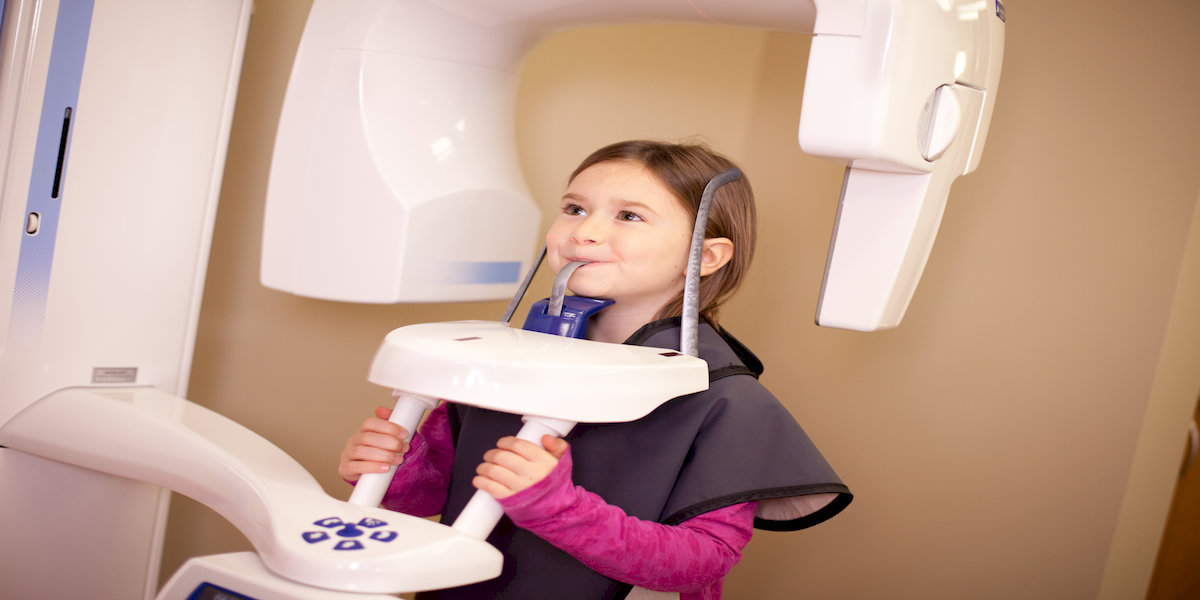
Depending on what the clinical exam reveals, dental X-rays may be recommended to provide a more complete picture. Panoramic radiographs allow our team to see the position of unerupted permanent teeth, check for any missing or extra teeth, and assess how eruption is progressing beneath the surface. All findings are reviewed with parents in detail, and we welcome questions at every stage of the conversation.
Signs That May Prompt an Earlier Evaluation
While we recommend a first evaluation by age seven for every child, certain observations may make it worth scheduling sooner. If you notice any of the following, contact our Sunnyvale team to discuss whether an earlier evaluation makes sense:
- Baby teeth lost significantly earlier or later than expected
- Crowding or overlapping of the front teeth as they come in
- Difficulty biting, chewing, or a jaw that clicks or shifts when opening
- Mouth breathing, snoring, or signs of a potential airway concern
- A noticeable underbite, overbite, or crossbite developing
- Persistent oral habits such as thumb sucking that may have affected jaw development
An earlier evaluation in response to these signs is always appropriate, and catching issues while options are most plentiful is always in a child’s best interest.
Bay Area Kids Dentist: Orthodontic Evaluations in Sunnyvale
At Bay Area Kids Dentist, we take a thorough and forward-thinking approach to monitoring how each child’s smile is developing over time. Our Sunnyvale team is warm, communicative, and committed to making every visit an experience that both children and parents feel comfortable with. We explain our findings clearly at every appointment and never recommend treatment unless it genuinely serves the child’s long-term oral health. We accept Delta Dental PPO, Cigna Dental, and TRICARE, and offer flexible payment options including CareCredit, Cherry, and HSA/FSA to make comprehensive care accessible for your family.
If your child is approaching age seven or if you have noticed any concerns about how their teeth or bite are developing, we encourage you to schedule an evaluation with our Sunnyvale team. Reach out through our contact form and let us help give your child’s smile the early attention that sets it up for long-term success.
Bay Area Kids Dentist — Sunnyvale
1565 Hollenbeck Ave STE 102, Sunnyvale, CA 94087
(408) 520-2656
Frequently Asked Questions About Orthodontic Evaluations in Sunnyvale
When should my child have their first orthodontic evaluation?
The American Association of Orthodontists recommends a first orthodontic evaluation by age seven. At this age, the first permanent molars have typically emerged, giving a trained clinician enough of a dental framework to assess how the bite is forming. Early evaluation does not mean early treatment — for many children, the outcome is simply monitoring. But for those with issues that respond best to early intervention, catching them at seven rather than twelve or thirteen can meaningfully reduce the complexity and cost of later treatment.
What does an orthodontic evaluation at Bay Area Kids Dentist include?
A pediatric orthodontic evaluation includes a clinical examination of the teeth and bite, observation of how the upper and lower jaws relate when your child bites and chews, assessment of the face and profile, and a review of any relevant X-rays. Our team checks for crowding, spacing, crossbites, underbites, overbites, and any signs of problems with how the permanent teeth are erupting below the surface. All findings are reviewed with parents in detail.
Does an early orthodontic evaluation mean my child will need braces?
Not necessarily. The most common outcome of an early evaluation is reassurance — we confirm that development is progressing normally and continue monitoring at routine visits. The second outcome is a monitoring schedule with periodic check-ins. Only when a problem is identified that responds best to early intervention do we recommend treatment, and we always explain the nature of the issue, the options available, and the timeline before anything begins.
What is interceptive orthodontic treatment?
Interceptive orthodontic treatment refers to intervention during childhood that takes advantage of active jaw growth to correct problems before they become more serious or complex. Common examples include palatal expansion to address a crossbite or narrow arch, space maintenance after early loss of a baby tooth, and appliances to address habits like thumb sucking that may be affecting jaw development. Interceptive treatment does not always eliminate the need for braces later, but it can significantly simplify subsequent treatment.
Are there signs my child should be evaluated before age seven?
Yes. Consider scheduling earlier if you notice baby teeth being lost significantly earlier or later than expected, crowding or overlapping of the front teeth, difficulty biting or chewing, a jaw that shifts or clicks, signs of mouth breathing, a noticeable underbite or crossbite developing, or persistent habits like thumb sucking. Earlier evaluation in response to these signs gives us more options for intervention.
Does insurance cover the orthodontic evaluation?
Orthodontic evaluations are generally not a separate charge and are incorporated into your child's comprehensive dental exam, which is covered under most preventive benefits. Any interceptive treatment that is recommended is discussed individually with insurance coverage reviewed beforehand. Bay Area Kids Dentist accepts Delta Dental PPO, Cigna Dental, and TRICARE, and offers CareCredit, Cherry, and HSA/FSA for out-of-pocket portions.
Problems We Treat
 Emergency Tooth Extraction
- Severe Toothache
- Loose or Dislodged Tooth
- Bleeding Gums
- Knocked Out Tooth
- Infection or Swelling in the Mouth
- Jaw Pain
- Chipped or Cracked Tooth


Sealants
Dental sealants are a thin coating of composite material that forms a hardened shield over the tooth...

Silver Diamine Fluoride
At Bay Area Kids Dentist in Sunnyvale, CA, we offer silver diamine fluoride (SDF) as an innovative solution...

Digital X-Rays
Our dental clinic is equipped with digital X-rays, ensuring the safest and most effective imaging for your child...

Dietary Counseling
At Bay Area Kids Dentist in Sunnyvale, CA, we are aware that diet plays a crucial role in maintaining your child's oral health.

Oral Hygiene Instruction
Startlingly, the American Academy of Pediatric Dentistry reports that tooth decay affects a staggering 40% of children...
In-office prescription toothpaste available
At Bay Area Kids Dentist in Sunnyvale, CA, we offer in-office prescription toothpaste designed to enhance your child’s tooth...

First Appointment
At Bay Area Kids Dentist, we understand that a toddler's first dental appointment is an important step...

Pediatric Emergency Dental Care
At Bay Area Kids Dentist in Sunnyvale, CA, we specialize in providing prompt and effective emergency pediatric dental care...

Laughing Gas
Laughing gas, publicly known as nitrous oxide, helps children who are highly fearful of the dentist feel more relaxed...

Sedation Dentistry
At Bay Area Kids Dentist in Sunnyvale, CA, we perform a range of sedation options to ensure your child's comfort...

Special Needs Dental Care
At Bay Area Kids Dentist in Sunnyvale, CA, we recognize the unique challenges children with special health needs face...

Tooth Extractions
At Bay Area Kids Dentist in Sunnyvale, CA, we offer expert tooth extraction services tailored to the unique needs of children...

Space Maintainers
When a child loses a baby tooth early, the surrounding teeth might shift into the space, leading to alignment...

White Filling
At Bay Area Kids Dentist in Sunnyvale, CA, we provide practical solutions for child tooth decay...
